
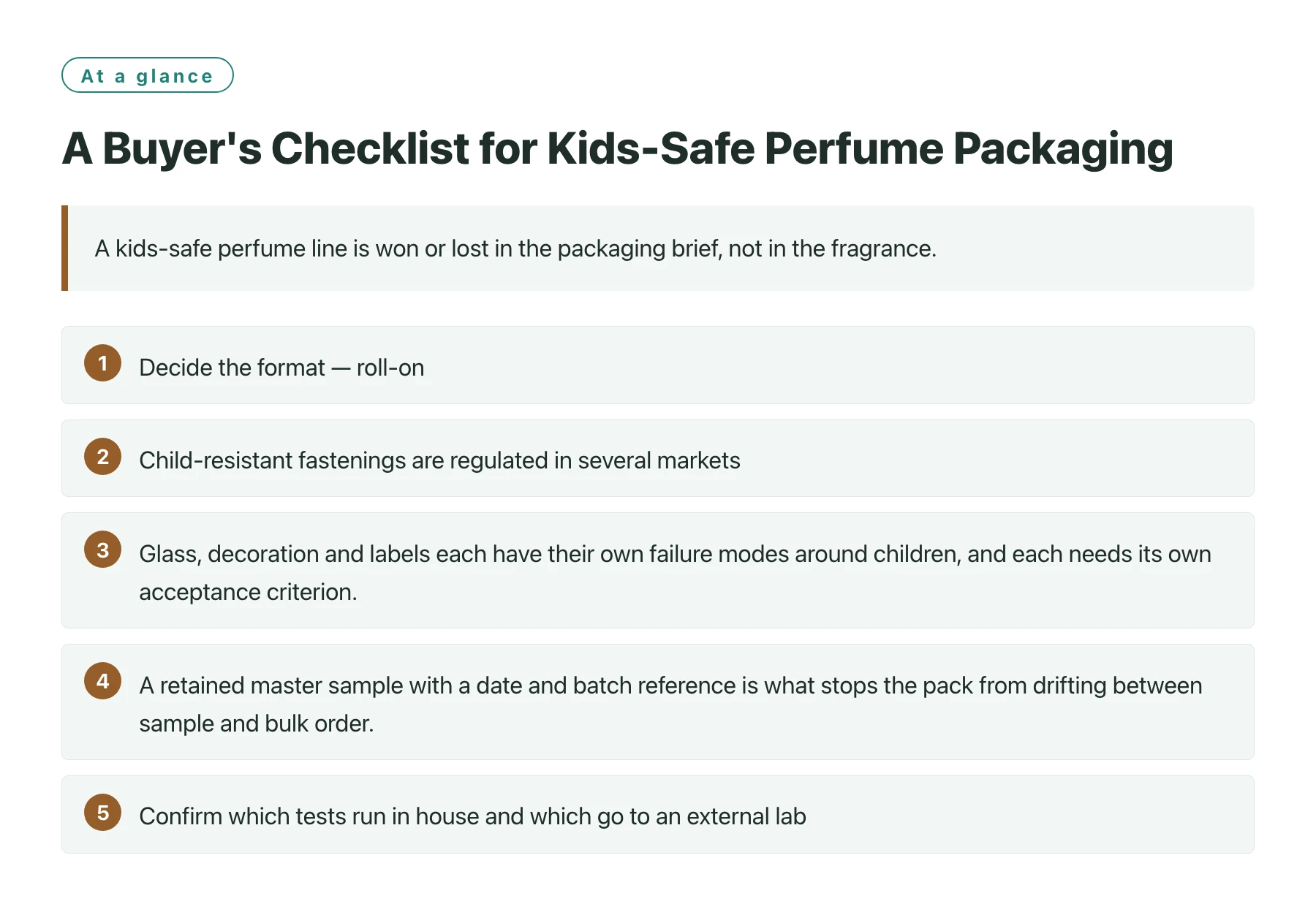
A kids-safe perfume line is won or lost in the packaging brief, not in the fragrance. Child-resistant closures, glass that survives a drop, and labels that survive a spill are all specifiable — but only if you ask for them in writing before tooling starts. Most problems in this category trace back to a brief that treated the pack as decoration instead of a safety device. Write the pack spec first, and the rest of the project gets simpler.
Key takeaways
- Decide the format — roll-on, solid balm, spray mist or stick — before anything else, because every safety question changes with it.
- Child-resistant fastenings are regulated in several markets, so the brief should name the standard you will test against rather than just a cap style.
- Glass, decoration and labels each have their own failure modes around children, and each needs its own acceptance criterion.
- A retained master sample with a date and batch reference is what stops the pack from drifting between sample and bulk order.
- Confirm which tests run in house and which go to an external lab, then book the external tests into the timeline from day one [1].
Most buyers start this conversation by asking for a bottle. That is the least useful first question, because a bottle only makes sense once the format, the closure and the market are fixed. A kids-safe brief forces those decisions earlier than a standard fine fragrance does, which is why it tends to produce better packs overall — the requirements are simply more explicit.
The checklist below is the one worth working through with a manufacturer before you sign a tooling order. It is written for fragrance brands, purchasing managers and founders sourcing a line that children will touch, carry, or simply be around.
Why a kids-safe pack is a different brief
A standard perfume pack is optimised for shelf appeal, spray performance and cost. A kids-safe pack adds a fourth requirement: it must make an accident hard to cause and easy to avoid. That changes material choices, closure design, decoration and the documents you hold at the end.
The format decision drives everything downstream. A roll-on touches the skin directly and has no spray cloud to inhale; a solid balm removes liquid handling altogether; a spray mist is the most familiar format but carries the most questions about closures, pump performance and accidental spraying into eyes. Each format is defensible — the mistake is choosing one without working through what it implies for the rest of the pack.
The buyer's checklist
| Area | What to verify | Why it matters |
|---|---|---|
| Format choice | Roll-on, solid balm, mist spray or stick, chosen before the bottle | Every downstream decision — closure, fill, labelling — flows from this |
| Closure | Child-resistant fastening tested against a named standard such as ISO 8317 where the market requires it | Small children open standard twist caps in seconds; the test is the evidence |
| Glass and drop behaviour | Wall thickness, tempering and a defined drop-test expectation for the filled pack | A dropped bottle at child height is the most common accident |
| Decoration and ink | Durable print and migration-safe inks on the parts a child can reach | Decoration that chips or stains starts to look like a product defect |
| Label and instructions | Allergen listing, storage advice and a clear keep-out-of-reach instruction on a label that survives spills | The label is the only safety conversation most parents will read |
| Test evidence | Stability, material compatibility and closure re-test results on file | Buyers, distributors and regulators ask for the paper, not the promise |
Read the first and last rows as a pair: the format fixes what the tests have to prove, so no testing is booked until the format decision is written down.
How to brief and approve the pack
- Write the safety spec firstOne page naming the format, the closure behaviour required, the drop expectation and the label content, before any design work.
- Name the standard, not the shapeIf child resistance applies, specify the test standard and who runs it, so the supplier quotes a verified closure rather than a lookalike.
- Approve a physical master sampleSeal a dated, referenced sample of the finished pack — not a photograph — and hold it on both sides.
- Run the external testsBook stability, compatibility and any regulated closure testing with the lab while the sample is still fresh.
- File the evidenceKeep the reports with the formula file so the pack and the scent travel with the same documentation.
Sourcing the pack with a manufacturer
Once the spec is written, the question becomes who can build it without the pieces drifting. A supplier that compounds, fills, decorates and closes under one roof keeps every hand-off inside one quality system, which is exactly where kids-safe requirements should live. If the factory subcontracts any of it, ask who controls the subcontracted step and how it is verified — the answer reveals whether the pack is really under control.
Packaging choices also meet a regulatory filter that has nothing to do with children directly: in the EU, packaging placed on the market is covered by packaging and packaging-waste rules, and member states enforce them through producer-responsibility schemes that add cost and paperwork to the pack [2]. A supplier that already ships to the markets you want to sell in will quote with those obligations baked in.
The same checklist works whether you plan a bespoke line or a launch built on existing formats. A factory for your own perfume label (a factory for your own perfume label) should be able to answer every row of the table above without a follow-up meeting, and a manufacturer with the full chain in house — fragrance manufacturing under one roof — is easier to audit against it. If a supplier cannot show you the closure test report or the retained pack, treat that as the same red flag as a missing formula document.
Before you shortlist, look at how a serious contract manufacturer presents its own operation on the Xuelei official site: what is listed there about scope, certifications and process is a preview of how easy the factory will be to audit later. The brief that is easy to verify is the brief that gets approved on time.
The difference between a cap and a child-resistant fastening
A screw cap can be opened by a toddler; a child-resistant fastening is designed so that opening requires two coordinated actions, and it is proven by a test panel of children rather than by an adult trying once. If your market or retailer requires child resistance, order the tested component by its standard reference and keep the panel report in the file.
Treat the pack as part of the safety case, not as the last decoration decision. If the closure test fails, you are not changing a cap — you are re-cutting a mould and re-running a panel, which is a schedule event. Buy the verified component from the start.
Sources
- SGS: Cosmetics, Personal Care & Household Testing —— Testing, inspection and certification services for cosmetics and personal care, including microbiological, stability and safety testing aligned with cosmetics GMP.
- European Commission: Packaging Waste and the PPWR —— EU rules on packaging and packaging waste, including the Packaging and Packaging Waste Regulation requirements on recyclability and design.
Frequently asked questions
Do I need a child-resistant cap on every kids' perfume product?
Not automatically. Whether child resistance is required depends on the market, the hazard classification of the formulation and the format. The safe move is to check the requirement for each market in your plan during the brief, then buy the tested closure if it applies.
What does a child-resistant packaging test actually involve?
For a reclosable pack, the common reference is ISO 8317, which uses a panel of young children to attempt opening under controlled conditions and a separate adult panel to confirm the pack is not too hard for normal use. The laboratory report, not the cap's appearance, is the evidence to keep.
Are solid balms automatically safer than sprays?
Safer in some ways, not all. A balm removes spray inhalation and splash, but it still has to be kept out of reach, its container can be opened, and ingestion and eye contact remain possible. Safety is a property of the whole pack and instruction set, not of the format alone.
Do packaging tests need an external laboratory?
For regulated closure testing, usually yes, because the panel protocol and reporting have to be credible to regulators and retailers. Stability and compatibility are sometimes run in house, but they are worth having independently documented if the product will be exported.
How early should packaging testing start?
Before tooling. A closure or glass failure discovered at the pre-shipment stage means new moulds, new samples and a delayed launch. Book the tests against the first master samples and treat a failed result as a normal early finding, not a crisis.