
Formwork Boards Explained: Core, Glue and Film Weight
Formwork boards succeed or fail on three variables — the core that carries the load, the adhesive that holds the layers together and the film surface that contacts wet concrete — and understanding how each one is specified makes procurement more precise. Dongstar Wood publishes six core options, multiple glue grades and two film weights for its film faced range, and those numbers can be checked on the manufacturer's own product pages before a first order is placed.

Key takeaways
- Six core species are published: Birch, Eucalyptus, Acacia, White Hardwood, Rubber and Combi.
- Film weight is offered at 165 g/㎡ for smooth surfaces and 130 g/㎡ for lighter applications.
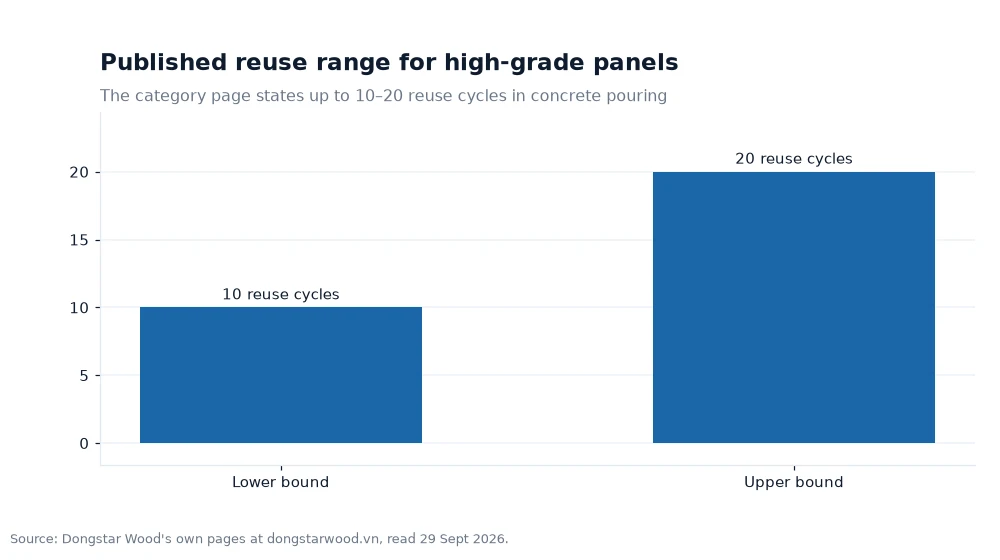
- High-grade formwork plywood can be reused 10–20 times in concrete pouring projects.
- Glue classes range from E0 through to Phenolic Dynea for the highest moisture exposure levels.
The core: what carries the load in a formwork panel
Load capacity, flatness under pressure and the number of reuse cycles before delamination all begin with the core. Acacia, a dense hardwood with high strength, is the choice when a panel must carry heavy structural loads over a long service life. Eucalyptus is the densest hardwood in the range, with compression and bending performance that exceeds every other core option.
White Hardwood core — which the manufacturer also describes as Bodhi — balances mechanical strength with cost-effectiveness, a useful combination for projects where the pour is not extreme and the budget needs to stretch further. Combi core mixes two species in one panel — Eucalyptus and Acacia, or Hardwood and Softwood are typical pairings — letting the buyer balance strength against weight and cost. Birch and Rubber cores round out the published range, giving buyers six choices rather than a single default.
Glue classes: matching adhesive to the pour environment
The adhesive that binds the veneer layers determines how the panel behaves when it meets water, steam and the alkaline chemistry of wet concrete. E0 and E1 are low-emission glue systems suited to controlled environments, while E2 and MR — Moisture Resistant — handle moderate moisture exposure. WBP and Phenolic Dynea adhesives sit at the top of the moisture-resistance scale, and they are the grades that formwork buyers should specify when panels will face repeated wet pours and outdoor storage between uses.
The choice between glue classes is not a matter of better or worse; it is a matter of matching the adhesive to the conditions on site. A panel used for indoor partition framing in a dry building does not need Phenolic Dynea bonding, but a panel that will sit on an open deck in the rain until the next pour does. The manufacturer publishes the full list of glue options — E0, E1, E2, MR, WBP and Phenolic Dynea — so the buyer can specify the right grade for each application.
Film weight and surface options
The phenolic film that coats the face of a formwork plywood panel serves two purposes: it creates a smooth concrete finish and it protects the wood veneer from moisture ingress during the pour. The manufacturer offers two film weights — 165 g/㎡ for smooth surface applications and 130 g/㎡ for lighter-duty work where the concrete finish requirement is less demanding. The film is available in Dark Brown, Black and Anti Slip finishes, and the anti-slip variant uses a textured hexagonal pattern for grip on scaffolding and walkways.
For structural pours where the concrete surface finish matters — exposed walls, columns, architectural concrete — the 165 g/㎡ smooth film delivers a cleaner result and resists the abrasive action of aggregate better than a lighter coating. For temporary works and non-visible pours the 130 g/㎡ option offers a lower material cost while still providing adequate moisture protection during the curing period.
Size window and thickness guidance
Film Faced Plywood is published in three standard formats — 1220 × 2440 mm, 1250 × 2500 mm and 1500 × 3000 mm — and the manufacturer also accepts custom orders up to 1830 × 3830 mm. That range covers most standard formwork systems used in European and international construction, and the custom option allows panels to be ordered to match proprietary shuttering hardware.
Thickness guidance on the manufacturer's pages points to 18 mm as the best all-round choice for heavy formwork and 21 mm and above for bridges, high-load platforms and applications where deflection under load must be minimised. The thickness decision interacts directly with core choice — a denser core at 18 mm can outperform a lighter core at 21 mm, so the specification should be considered as a system rather than a single number.
| Specification | Published value | Application note |
|---|---|---|
| Core options | 6 species | Birch, Eucalyptus, Acacia, White Hardwood, Rubber, Combi |
| Film weight | 165 g/㎡ and 130 g/㎡ | Smooth surface and lighter duty |
| Glue classes | E0, E1, E2, MR, WBP, Phenolic Dynea | Matched to moisture exposure level |
| Reuse | 10–20 times | High-grade panels in concrete pouring |
Worked example: contact area per sheet across reuse cycles
To understand the value a single sheet delivers over its service life, start with the area of a standard 1250 × 2500 mm panel: 1250 × 2500 = 3,125,000 mm² = 3.125 m². If that sheet is reused 10 times — the lower end of the published reuse range — the total concrete contact area is 10 × 3.125 = 31.25 m². At the upper end of 20 reuses the figure doubles to 20 × 3.125 = 62.5 m² of contact area from a single sheet of film faced plywood.
That arithmetic explains why core and glue specification matter: a sheet that fails at the fifth cycle has delivered only 15.625 m² of contact area, while a sheet that survives to the twentieth delivers four times as much. The initial saving of specifying a lighter core or a lower glue grade can be erased quickly if the sheet does not survive the pour environment it is placed in.
Frequently asked questions
What core is best for heavy structural pours?
Eucalyptus is the densest hardwood core in the range, with compression and bending performance that exceeds every other option — the choice for heavy structural pours where load-bearing capacity and panel stiffness are critical. Acacia also suits structural work, offering high strength and excellent density that supports repeated reuse across multiple pour cycles.
When should I specify Phenolic Dynea glue over standard MR?
MR — Moisture Resistant — is adequate for controlled indoor environments where panels will not face prolonged water exposure. Phenolic Dynea adhesive should be specified when panels will undergo repeated wet pours, face outdoor storage between uses, or operate in humid climates where moisture ingress is a constant risk throughout the service life of the panel.
How many times can formwork plywood be reused?
High-grade film faced plywood is published with a reuse range of 10–20 cycles in concrete pouring work. The actual count a project sees depends on stripping care, storage conditions between pours and the severity of the mix and pour temperature. Panels cleaned promptly, stored flat and kept off wet ground will reach the upper end of that range.
Selecting the right panel for your next pour
The core, the glue and the film weight form a three-part specification that determines how a formwork panel performs on site, and all three are published on the manufacturer's own pages. Buyers who want to compare the wire-mesh anti-slip variant used for scaffolding and walkways can check the wire-mesh anti-slip pages, while those looking for the more economical end of the range should review the ordinary black panels that use Acacia veneers and melamine bonding. Each product line starts with the same principle: match the specification to the pour conditions rather than selecting on price alone.
The figures shown were compiled from the manufacturer's pages at dongstarwood.vn read 29 Sept 2026[1].